

Bauxite mining
Contents
The extent of strip-mining
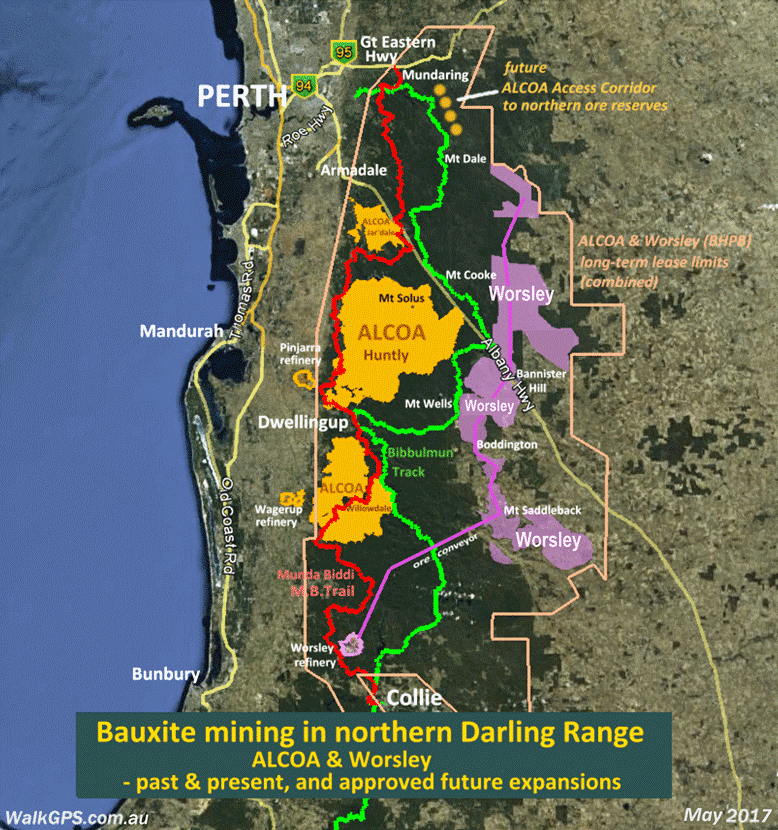
Huge, long-term mining leases held by ALCOA and South32 (Worsley Alumina) cover a total area of almost 10,000 sq km, across most of the northern Darling Range State forests and drinking water catchment areas. They include a majority of the walk areas on WalkGPS. Strip-mining for bauxite first commenced at Jarrahdale in 1963 and major expansions of mining operations within the leases have since been approved by Government.
Additional leases in the north are also being explored by other companies, indicating a possibility that mining will eventually extend beyond the Alcoa and Worsley leases (including for nickel in Julimar Conservation Park).
Impact on bushwalking
Continuing expansions of the mining will increasingly impact on and greatly diminish quality bushwalking opportunities in the region in coming years. Bushwalking areas to be affected by the mining will in the future stretch from Bannister Hill in the south to at least as far north as the Ngangaguringguring Hill area. (See listing of at least 35 walks likely to be impacted.) Further south the expansion of the Willowdale operations into Lane Poole Reserve south of Dwellingup reached within 1km of the Murray Campsite on the Bibbulmun Track. (Click for time lapse image of Willowdale operations for 1987-2016 period.)
Changing conservation priorities
Over the decades since the mining began, some new national parks have been declared in the Darling Range, but some forest conservation areas proposed in a 1994 plan were later greatly modified. These affected the proposed Gyngoorda Conservation Park around the Bannister Hill walk area and the proposed Gibbs Conservation Park around upper Dale River walk area. The changes evidently accommodate Worsley’s evolving mining expansion priorities. In the current Forest Management Plan produced by the Conservation & Parks Commission of W.A., the area of the proposed ‘reinstated’ Gyngoorda CP is 1350ha, less than 40% of the original planned area, and no longer protecting the whole of Bannister Hill; The total area of the proposed Gibbs CP has been reduced to 2280ha, also less than 40% of the original. (See WalkGPS video below.)
South32 (Worsley Alumina) mining expansion
South32, in 2008 gained environmental approval for a future major expansion of Worsley Alumina’s operations within their 2900 sq km lease. The Environmental Protection Authority is an independent body with the broad objective of protecting the State’s environment. One of the EPA’s responsibilities to the community is to ensure that existing and planned recreational uses are not compromised. Worsley’s mining expansion environmental submission (‘ERMP’) in 2005 was misleading, stating that “most of the identified [recreational] sites [within and near the proposed mining areas] are in the area around the Bibbulmun Track” though acknowledging in the same document a number of affected walk areas that were published on WalkGPS and clearly remote from the Bibbulmun Track (ref. Osborne/WalkGPS, submission to EPA, 2005 ).
ALCOA mining expansions
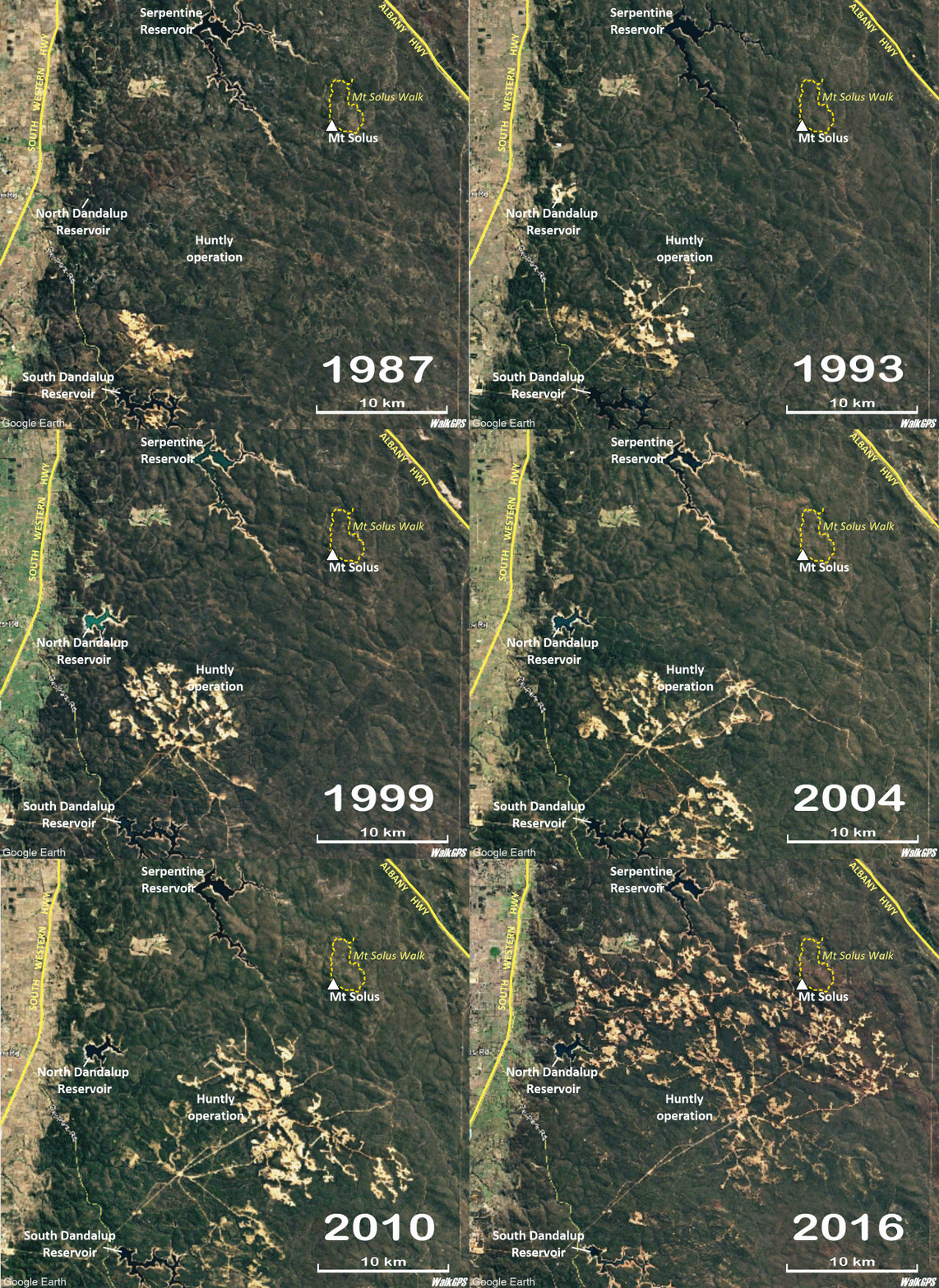
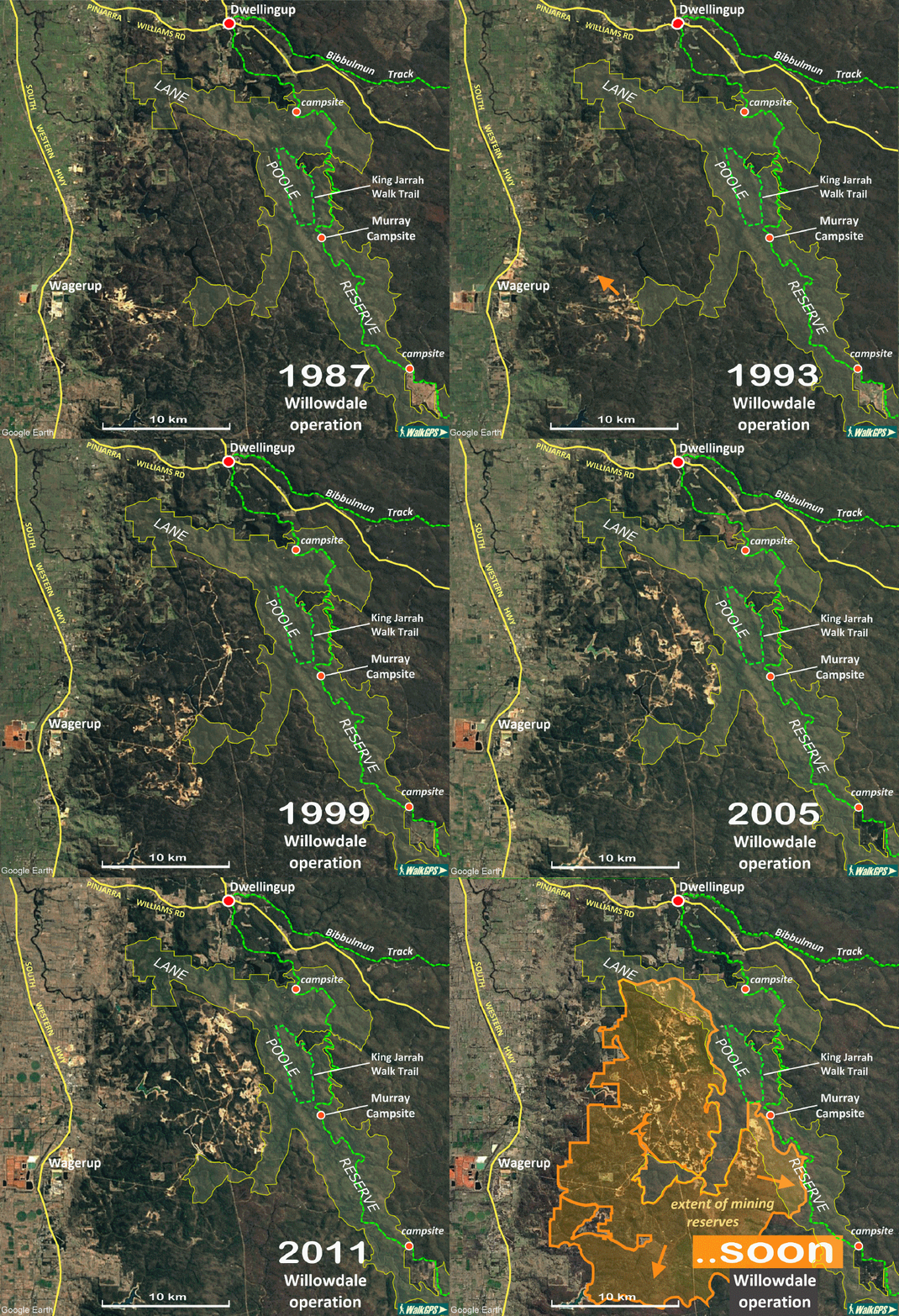
Over the years ALCOA has greatly accelerated the rate of removal of mature forest for the mining. For ALCOA’s Huntly operation alone, the gross area so far affected is now over 600 sq km and the gross mining footprint is expanding at a rate of over 3000ha a year around the Mount Solus area (see time lapse image for 1987-2016 period). In 2020 ALCOA proposed a major expansion of mining around the Huntly area (see map). Later revised proposals and plans will almost double the gross mined/mining envelope between Jarrahdale and Dwellingup from around 550 sq km to around 1060 sq km. An exploration envelope would cover a further 1780 sq km to just 17km south of Mundaring and 22km north of Collie. The proposals are now subject to a Public Environmental Review in 2025.
Environmental impacts
“Sustainable bauxite mining” is an oxymoron.
Impacts on forest and landscape – The extraordinary accelerated rate of expansion is surely outstripping the forest’s ability to eventually recover. Despite the miners’ claims of globally unparalleled excellence in rehabilitation of mined native forest areas, huge areas of mature forest habitat on Perth’s doorstep are being lost. The degraded landscape is quickly and cosmetically re-greened by the miners, but independent experts are increasingly sceptical about the miners’ assurances that this young replacement forest will thrive in the longer term. (ref. “Undermined”).
Only about 15% of the land area within ALCOA’s 7000 sq km lease is protected within existing or proposed national parks and Lane Poole Reserve; most of the remaining 85% (~5900 sq km) will eventually be directly mined or otherwise impacted and fragmented by mining. Alcoa has previously claimed that “over an expected 100-year or so life of the viable bauxite reserves, [the company] will have disturbed [only] 5.6% of the northern jarrah forest”. Today satellite imagery across the Huntly operation reveals that the actual disturbance is much greater and is increasing at an unprecedented rate. Before mining is completed more than 60% of the mature northern jarrah forest and wandoo woodlands close to Perth will have been cleared or fragmented by mining and will include extensive areas of ‘rehabilitated’ former minesites. HikeWest (formerly ‘Bushwalking WA’), as the peak body for bushwalking in the State, in a March 2018 submission to a national senate inquiry into minesite rehabilitation has noted that walkers will in the future avoid the rehabilitated minesite areas as the severely altered condition of the landscape and vegetation is unsuitable for enjoyable bushwalking.
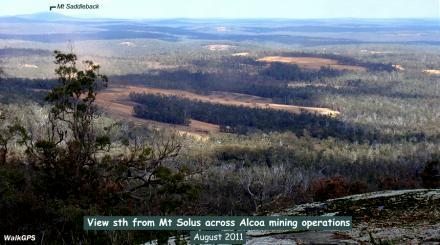 Impact on water resources – In a 2007 article “Bauxite Mining in Jarrah Forests” Roger Underwood, a former General Manager of W.A. Department of Conservation and Land Management (CALM), noted that “Apart from the loss of native forest, there has been a significant loss of run-off into streams and dams in the mined-over catchment areas. Pits have been designed to retain rather than shed rainfall, so run-off to forest streams is close to zero, and in many cases old mine pits cover nearly 50% of each sub-catchment. This has obvious impacts on water resources and aquatic ecosystems.”
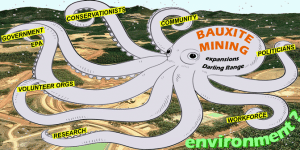 CSIRO has measured the substantial decreases in water yield from mined catchment areas. The cost to the State to boost desalination to replace this loss in drinking water availability is now likely to annually exceed the royalties paid to the State by the miners (for details see F. Batini, FIFA, 2016). But the DoW in its published Plans of 2007 was more concerned with the impact of bushwalkers than with bauxite miners: Its “Mundaring Weir Catchment Area Drinking Water Source Protection Plan” considered perceived risks of bushwalking and camping activities on water quality but made no mention of the substantial impact planned future mining will have within that same catchment and its risks for water run-off. The DoW’s “Canning River Catchment…Plan” noted only that “bauxite mining does not currently occur in the catchment” but will be “acceptable if operated in compliance with conditions…”.
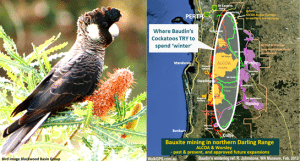 Deficiencies of old State Agreements – A Federal senate inquiry on mine rehabilitation in WA in March 2018 revealed that the state agreements that companies such as Alcoa operate under in WA result in contradictory situations in environmental planning, and in some cases override federal environmental controls. An environmental asset such as aged forest within the Alcoa lease, providing nesting hollows for endangered black cockatoos, took hundreds of years to develop. Yet Alcoa is able to remove potential black cockatoo habitat without recourse to the federal act applying to companies not operating under state agreement acts. The inquiry noted that Alcoa could not restore aged forest – the prime habitat for black cockatoos. (See article “Mine rehab in WA is the pits..” , Young, 2018.)
Public awareness
For much of the past 40 years the general public has been poorly informed as to what has been happening to the Northern Jarrah Forest and the consequences for future generations. The battle to stop early expansions of the strip-mining was lost by conservationists back in the early 1980’s. The Campaign to Save Native Forests continued to fight for conservation of our forests; the impacts of mining were no longer a focus but CSNF publications such as “Forests on Foot – 40 walks…” (Meney & Brown 1985) encouraged continuing public awareness and connection to our forests. More recently, public awareness has greatly increased leading up to a major Public Environmental Review (PER) in 2025 of Alcoa’s major expansion proposals and plans.
Consultation?
The State forests affected by the mining have multiple uses. Recreational bushwalking is one legitimate use and ‘free-range’ /off-trail walking is a ‘supported’ activity across most of the State forests, within the outer water catchments (i.e. beyond a 2km wide protection zones around the reservoirs). The miners have been required to submit updated mining plans annually for approval to a multi-agency liaison group (‘MMPLG’) so that the activities of other forest users can be integrated. But this group had no community representation or public accountability; And the miners’ narrowly focused consultation processes have tended to bypass the broader community including bushwalkers. The miners’ claimed “social licence to operate” cannot be legitimate in the absence of transparency and proper consultation with the wider community on the impacts of the mining. The PER of the current mining management and expansion proposals in 2025 is a first opportunity for the community to have its voice properly heard.
One local community’s impact
The Dwellingup Community in late 2017 released a position statement and local action plan on the best way to protect Dwellingup from the detrimental impacts of bauxite mining, including particularly, conservation biodiversity, landscape amenity loss and the resulting loss of Dwellingup’s capacity to attract visitors. The community proposed a bauxite mining exclusion zone (the “Dwellingup Discovery Forest”) to protect Dwellingup values for nature tourism. The position statement also listed several of the community’s concerns, including in part (in summary):
-
- lack of engagement of the miner (Alcoa) and State Government with the local community in problem resolution;
- lack of State Government policies to protect multiple-use forest management values including traditional recreation;
- encouragement of miners (under State Agreements) to provide donated funding aimed at meeting company – as distinct from community – objectives;
- lack of recognition of difference between multiple-use forest management values and non-renewable resource extraction and the irreversible changes to biodiversity, landscape and unique soil profiles.
Alcoa, in its belated response, initially announced in June 2023 that it would not mine within an 83 sq km zone around Dwellingup; covering only 30% of the area that the local Dwellingup community group had initially proposed as the Dwellingup Discovery Forest. Then in December 2025, Alcoa announced it had more than doubled the Mining Avoidance Zone (MAZ) around Dwellingup to 260 sq km. Though the MAZ expansion was initially welcomed by the local shire, Alcoa still plans to mine across a 25 sq km forested area east of the town and north of Inglehope; an area of high value to the community as a key part of their original Dwellingup Discovery Forest concept. Much of the area that Alcoa has ‘given up’ to the MAZ in fact had no realistic prospect of future mining due to having been previously mined or being located within a reservoir protection zone.
The legacy
Future generations may well ask in dismay how any growing city could have allowed a once extensive mature and unique forest right on its doorstep to be so plundered and degraded. As Roger Underwood, also said in his 2007 article:
“One of the most interesting anomalies in Australian environmentalism is that the alumina industry is destroying the jarrah forest – and nobody seems to care. At least, nobody is complaining.” “…..there will come a time in the not-too-distant future when West Australians realise what has gone on, and the extent and cost of the ecological damage which has occurred. Then perhaps they will look back on the …. destruction of the jarrah forest by bauxite mining as one of the greatest conservation blunders in our history.”
Where to now?
A record 59,000 public submissions were received by the Environmental Protection Authority in 2025 during the Public Environmental Review of Alcoa’s major expansion proposals and plans. Following the PER process, the public has high expectations that: 1) the EPA will deliver strong recommendations to the Minister in 2026, including the Government actions necessary to avoid the destruction of the remaining jarrah forest; and that 2) the State Government will heed that advice.
“Bannister Hill – once was a Conservation Park” – WalkGPS video.
(length = 3:59 minutes)
Alternatively: Click here to view the video on Vimeo.
Additional information
“A thousand cuts – Mining in the Northern Jarrah Forests” – report by Project NJF (WA Forest Alliance, Wilderness Society, CCWA), 2022.
“Alcoa proposed Myara North and Holyoake mining expansions, mining leases, and Bibbulmun Track overlaid on DBCA map of mine clearing and ‘rehabilitation” – courtesy WalkGPS (after DBCA Parks & Wildlife), Aug. 2021.
“Bauxite mining” – HikeWest (WA’s peak hiking / bushwalking body) – web page.
“Changing the Mt Solus landscape” – WalkGPS video.
“Disappearing wandoo woodlands & laterite breakaways” – WalkGPS video.
“Avoiding the mining” – HikeWest, June 2023.
“Fighting for the Forests – A history of the Western Australian forest protest movement 1895-2001” – Ron Chapman doctoral thesis, 2008. (Murdoch University Research Repository).
“Impact of bauxite mining on water yield” – F. Batini FIFA (from “Managing forested catchments – threats and opportunities”, Institute of Foresters Australia workshop, 2016). Presentation.
“Last chance: New WA plan will profoundly impact our jarrah forests” – Dave Osborne, President, HikeWest, WA Today, 12 Dec. 2022.
“Mine rehab in WA is the pits: Inquiry finds few success stories” – Emma Young article, WA Today, 9 Mar. 2018.
“Mostly out of sight and mined?” – Dave Osborne article, Aug. 2013. (Shorter version was published in “Wild” magazine, issue #138, Nov.-Dec. 2013, as “Bauxite vs bushwalking”.)
“Position Paper – Mining Impacts on Hiking in the Darling Range” – HikeWest, July 2025.
“Save our Jarrah” – Jarrahdale Forest Protectors.
“Statement on Bauxite Mining and Revegetation in the Northern Jarrah Forest” – Forestry Australia, February 2022.
Submission to Environmental Protection Authority on Alcoa Bauxite mining proposals – HikeWest, 21 August 2025.
Submission to Environmental Protection Authority on Worsley Alumina Pty Ltd Expansion Environmental Review and Management Programme – D.G. Osborne (WalkGPS), 1 August 2005
“The “Thousand Cuts” report – bauxite mining’s #1 role in deforestation in Western Australia” – HikeWest (WA’s peak bushwalking body) – website post, 8 May 2022.
“To run or tread water on national parks” – HikeWest (WA’s peak hiking / bushwalking body) – web post.
“To what extent can mine rehabilitation restore recreational use of forest land? Learning from 50 years of practice in southwest Australia” – J.C.S. Rosa et al, scientific paper, Jan. 2020.
“The McGowan logic – sustainable native forest logging not environmentally acceptable, but widespread clearing of jarrah forest for bauxite is” – Robert Onfray, article in Australian Rural & Regional News, 6 May 2022.
“Undermined” – Victoria Laurie, article in The Weekend Australian Magazine, 13-14 August, p.22-25. Accessible via subscription only.
“What future for WA’s northern jarrah forest?” – Dave Osborne, Dec. 2021. (Online version of article published in “Wild” magazine, issue #182, Summer 2021.)
“What’s going on in the jarrah forest?” – Jack Bradshaw, Dec. 2021. (YouTube video; 4.5 min).
“Worsley Alumina Project Expansion- Environmental Review and Management Programme –Executive Summary” – Strategen for Worsley Alumina Pty Ltd, May 2005.